Faith and Spirituality in Comic Cooks
The following information was provided by Saren with Comic Vive.
Faith and spirituality have a lot of influence on both Marvel and DC's works. A couple of years ago, when I read Rage of the Red Lanterns, I was surprised to see that the Blue Lantern named Warth was obviously heavily inspired by the Hindu deity Ganesha. He even had the broken tusk and everything. It was fitting because in Hindu mythology, Ganesha stands for the belief that all obstacles and adversities can be overcome. Hope, basically.
Religious mythos can be the source for great stories. Vertigo's Lucifer series is one of the best comic book titles ever made, and it derives much of its background and detail from the Judeo-Christian tradition. There are significant changes, however. In mainstream Christianity, Lucifer/Satan is depicted as evil and generally the corrupter of all things that are good and right in the world. Of course, things are much deeper than that in the religion, but that is a decent overview. In the Lucifer series, its protagonist, Lucifer Morningstar is more of an anti-hero. He rebelled against Heaven because he felt that by creating him and predetermining his life, his father had robbed him of his right to choose his own destiny and bound him to the Presence's rules.
But that's not to say villains can't be drawn from religion as well. Earlier this year, Marvel published the event Chaos War, where an assortment of heroes (including Hercules and Thor, both drawn from mythology) went up against Amatsu-Mikaboshi, the Japanese god of evil and chaos. Elements of the villain's real world source were easy to see, such as his enmity with the Kami, Japan's Shinto gods.
One of the last issues of the 2009 Power Girl series (damn you for what you did to her, DC) featured a Muslim metahuman named Rayhan Mazhin, arrested by overzealous law enforcement on suspicion of being a terrorist, when in reality he was trying to save lives. The issue was sort of a statement against discrimination on the basis of religion or ethnicity (Batman called it "an egregious miscarriage of justice").
I could go on about religious influences on various characters. Wolfsbane and Nightcrawler are staunch Christians (Presbyterian and Catholic respectively), Thor and Hercules are gods (as are all the members of the pantheons they belong to), the Spectre is God's hitman, etc. The point is, religion and religious elements can be incorporated into stories that entertain without getting too preachy.
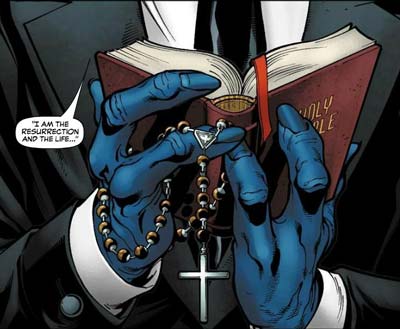
Unfortunately, there's the other end of the spectrum. While faith and spirituality can be celebrated in comics regardless of which religion they pertain to, some comics are filled with the denigration of religion, most of the time for impact or shock value. While I'm a big Vertigo fan, a prime example of this is the Vertigo series Preacher, where the Judeo-Christian God (this one's not the Presence) is portrayed as an insecure, tyrannical megalomaniac desperate for the love of his creations, and who would smite anyone who so much as thought of disagreeing with him.
There's a thin line between celebrating faith and mocking it
Religion in the Comic Book Code of 1954
Sometimes, religion is not only put in art, but also mandated to be in it. While the Comic Book Code of 1954 was not explicitly religious, it did line up very heavily with popular religious morals of the time. This information was provided by Michael J Cressler. The following is an excerpt from the Comic Book Code of 1954.
- "Inclusion of stories dealing with evil shall be used or shall be published only where the intent is to illustrate a moral issue and in no case shall evil be presented alluringly, nor so as to injure the sensibilities of the reader."
- "Scenes dealing with, or instruments associated with walking dead, torture, vampires and vampirism, ghouls, cannibalism, and werewolfism are prohibited."
- "Ridicule or attack on any religious or racial group is never permissible."
- "Divorce shall not be treated humorously nor represented as desirable."
- "Illicit sex relations are neither to be hinted at nor portrayed. Violent love scenes as well as sexual abnormalities are unacceptable."
This remarkable document speaks for itself and could be taught in a number of different contexts. You could read it alongside the Catholic Legion of Decency and its influence on the Motion Picture Association of America as an exemplar of the religious regulation of public morality, or as further evidence of the religious revival of the 1950s, in tandem with the addition of "God" to the Pledge of Allegiance and American currency.
Push Back
Some simply chose not to follow the rules of the code and would suffer the drop in sales because of it. Today, they do not suffer quite the drastic drop in sales that they once did. Some have even broken off and become much more "edgy" in their content. The following information was provided by Alex Johnson.
Comic books from edgier alternative publishers and adult-oriented graphic novels have explored explicitly religious ideas for several decades, but what’s striking is how often such themes have been appearing lately in the most mainstream of publications. For a character you can’t even see, God does seem to pop up all over the place in the comic book universe.
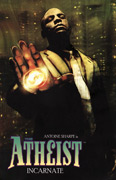
Or doesn’t. One of the more talked-about comic book debuts in recent years was the introduction last year of Antoine Sharpe, a government agent who rejects all things supernatural, by Desperado Publishing and Image Comics.
Sharpe’s rigid devotion to rationalism ("If your God falls out of Heaven tomorrow I’ll walk up, shake his hand, tug his beard, ask him who shot JFK, and then I’ll know God. Until then, he does not exist.") provides his nickname around the office — and the name of the series: "The Atheist."